Skip to content

We’ll help you pick the right one

Commercial Gym Storage Bays & Training Systems

Commercial gym storage bays combine gym equipment storage with a larger modular structure designed for organized, high-use fitness spaces. Choose from dedicated storage bays or integrated systems that add suspension training, rack stations, cable training, conditioning features, and other functional capabilities within the same footprint.

These systems are designed for commercial gyms, training studios, schools, hotels, apartment fitness centers, corporate gyms, and other facilities that need more than a basic storage rack. Use the filters to compare storage-only, suspension + storage, rack + storage, cable + storage, and functional + storage systems, along with bay size, mounting configuration, training features, and included accessories.

Browse by system type: Storage Only | Suspension + Storage | Rack + Storage | Cable + Storage | Functional + Storage

  • Gym interior with exercise equipment and TKO 9900 Stretching Boxing Rebounder Cables Station TKO_Stretching_Boxing_Rebounder_Cables_Station-9900 Save 9%
    Original Price $15,380.00
    Current Price $13,980.00
    TKO TKO Functional Training Station with Boxing and Cable System 9900

    Adjustable Design for Every Workout with the TKO Stretching+Boxing+Rebounder+Cables Station  The TKO Stretching+Boxing+Rebounder+Cables Station 990...

    View full details
  • TKO Double Half Rack DB-DHR Save 9%
    Original Price $13,400.00
    Current Price $12,182.00
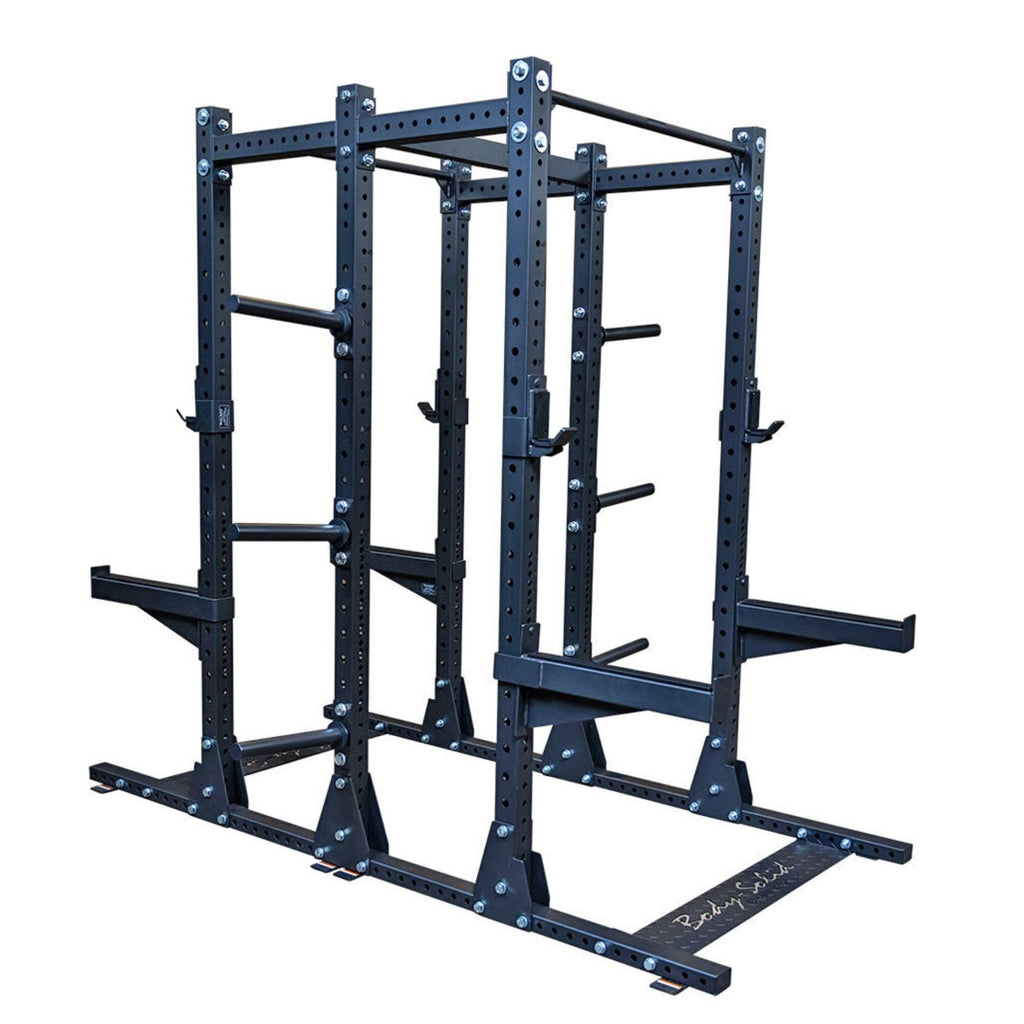
    TKO TKO Double Half Rack DB-DHR

    Adjustable Design for Every Workout with The TKO Corner Storage Suspension Bay Maximize gym efficiency with the TKO Double Half Rack DB-DHR – part ...

    View full details
  • A black TORQUE multi-functional home gym cable machine paired with a matching multi-tier weight rack holding dumbbells and kettlebells, set in a modern concrete-floored gym. Torque storage bay with weighted medicine balls on a 5 tier shelf with 6 kettle bells on the lower shelves. the storage bay also has a single cable column on the right side on a white background
    $10,948.00
    TORQUE TORQUE Cable Column Single Storage Wall System

    The Torque X-Create Apartment Gym System delivers full-body training, organized storage, and commercial-grade durability-without overwhelming your ...

    View full details
  • TKO Stretching+Combat+Functional Trainer 9908 Frame red TKO Stretching+Combat+Functional Trainer 9908 Save 9%
    Original Price $11,530.00
    Current Price $10,482.00
    TKO TKO Functional Trainer with Boxing and Stretching Station 9908

    Enhance Your Gym with the TKO 9908 Multi-Station Functional Trainer for Stretching and Combat The TKO 9908 Stretching-Combat-Functional Trainer is...

    View full details
  • TKO Stretching+Boxing+Rebounder Station 9903 frame TKO Stretching+Boxing+Rebounder Station 9903 Save 9%
    Original Price $8,830.00
    Current Price $8,030.00
    TKO TKO Boxing Rebounder Stretching 3 Station System 9903

    Transform Your Training with the TKO Stretching-Boxing-Rebounder Station 9903 The TKO Stretching-Boxing-Rebounder Station 9903 is an all-in-one, m...

    View full details
  • TKO Stretching+Rebounder+Power Rack Station 9902 fram TKO Stretching+Rebounder+Power Rack Station 9902 Save 9%
    Original Price $8,950.00
    Current Price $8,140.00
    TKO TKO Stretching Rebounder Power Rack 3 Station System 9902

    Adjustable Design for Every Workout with the TKO Stretching+Rebounder+Power Rack Station The TKO Stretching + Rebounder + Power Rack Station is a m...

    View full details
  • TKO Stretching+Boxing Station 9904 fram TKO Stretching+Boxing Station 9904 Save 9%
    Original Price $5,930.00
    Current Price $5,390.00
    TKO TKO Boxing and Stretching Station Compact Training System 9904

    Enhance Strength & Flexibility with the TKO Stretching and Boxing Station The TKO Stretching+Boxing Station 9904 is a compact, multi-functiona...

    View full details
  • TKO Functional Corner Unit, MATTE BLACK 9906-BK with background TKO Functional Corner Unit, MATTE BLACK 9906-BK Save 9%
    Original Price $5,660.00
    Current Price $5,148.00
    TKO TKO Functional Corner Unit Space Saving Gym System 9906

    Maximize Space & Efficiency with the TKO Functional Corner Unit The TKO Functional Corner Unit 9906-BK is a space-saving, multi-station traini...

    View full details
  • TKO Stretching+Rebounder Station 9905 fram TKO Stretching+Rebounder Station 9905 Save 9%
    Original Price $5,200.00
    Current Price $4,730.00
    TKO TKO Stretching Rebounder Station Compact Training System 9905

    Adjustable Design for Every Workout with The TKO Stretching+Rebounder Station The TKO Stretching+Rebounder Station 9905 is a versatile, space-savin...

    View full details

How to Choose a Commercial Storage Bay or Training System

A commercial storage bay can do much more than keep equipment off the floor. Depending on the system, the same footprint can organize dumbbells, kettlebells, medicine balls, plates, bars, bands, and accessories while also supporting suspension training, lifting, cable exercises, conditioning, or other training stations.

That makes the first decision less about finding the largest storage system and more about deciding what you need the space to accomplish.

If you already have enough training stations and simply need better organization, a storage-focused bay may be the smartest use of your budget. If floor space is limited, a system that combines storage with racks, suspension training, or cable stations may allow the same area to serve several purposes.

The sections below explain how these systems differ, how bay size affects capacity, and what to consider before choosing a configuration for your facility.

What Is a Commercial Gym Storage Bay?

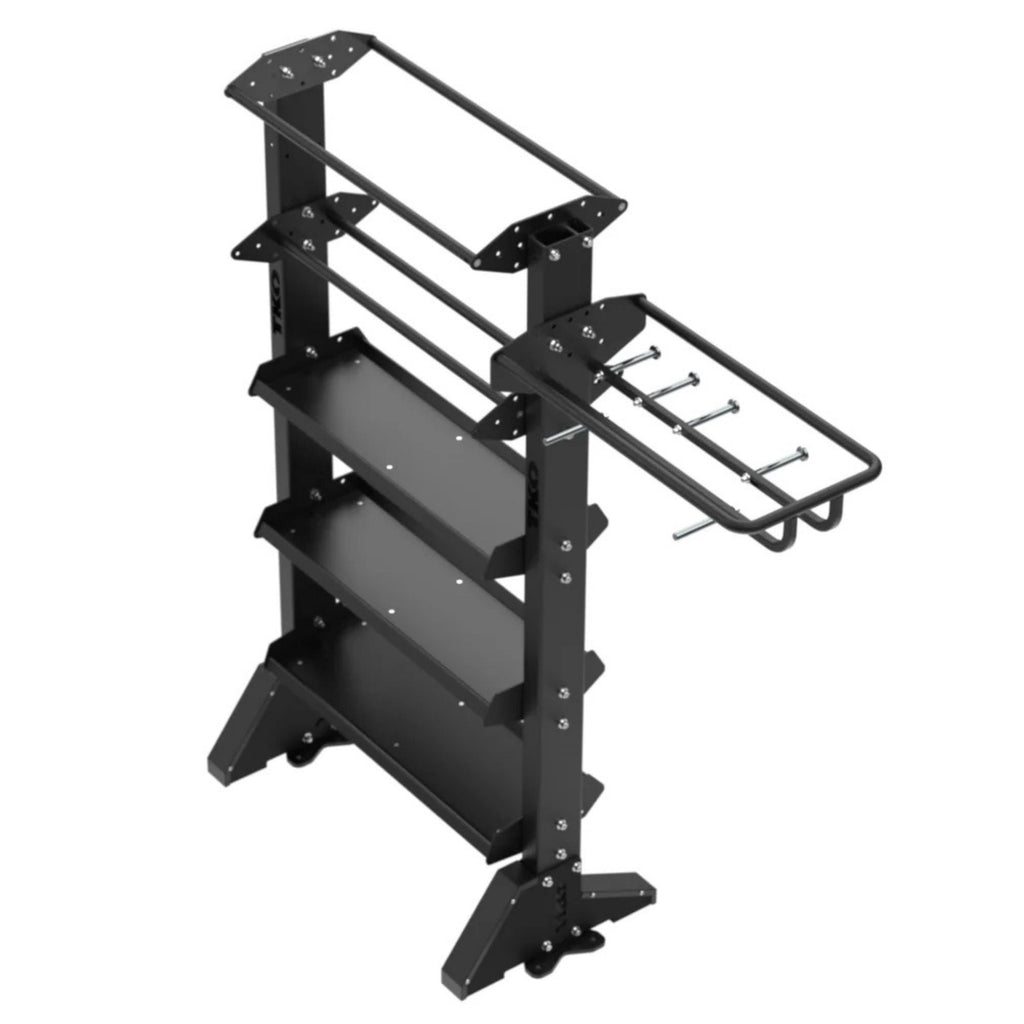
A commercial gym storage bay is a larger modular storage structure designed to organize multiple categories of fitness equipment within a defined section or series of sections called bays.

Unlike a small accessory rack or plate tree, these systems can provide dedicated shelves, trays, uprights, attachment points, and storage zones within one coordinated structure. Some remain entirely storage-focused, while others use those structural uprights to support training features.

Storage Bays vs. Standard Gym Storage

Standard commercial gym storage includes products such as dumbbell racks, plate trees, bar holders, kettlebell racks, shelving, and accessory organizers. Those products are usually designed around storing one particular equipment category.

A storage bay is larger and more modular. One system might organize medicine balls, kettlebells, bands, and other accessories across several shelves, while another may incorporate storage beside a rack, cable column, suspension station, or conditioning attachment.

If you simply need somewhere to store Olympic plates or bars, a dedicated storage rack will usually be the more practical choice. Storage bays become especially useful when you are trying to organize a larger training zone rather than one equipment category.

Storage-Only vs. Storage + Training

A storage-only system dedicates most or all of its structure to organization. This is useful for facilities that already have sufficient training equipment but need to control clutter and make frequently used accessories easier to find and return.

A storage + training system uses some of that same structural footprint for exercise. Depending on the model, that might mean suspension anchors, rack stations, cable columns, bridges, pull-up positions, heavy bags, conditioning equipment, or other integrated features.

Neither approach is automatically better. The important question is whether you need more storage, more training capacity, or both.

Understanding Storage + Training System Types

The easiest way to narrow this collection is by System Type. This tells you what role storage plays in the structure and what additional training capabilities, if any, the system provides.

Storage-Only Systems

Choose Storage Only when organization is the primary problem you are trying to solve.

These systems make sense for group training rooms, strength areas, and functional fitness spaces that already have enough racks and training stations but need organized storage for frequently used equipment.

They can also be a smarter investment than paying for integrated training features your facility will rarely use.

Suspension + Storage Systems

Suspension + Storage systems combine equipment organization with anchor points or stations for suspension-based training.

They can be especially useful in personal training studios, functional training areas, school fitness rooms, and group exercise environments because suspension trainers take relatively little storage space while supporting a wide variety of exercises.

Instead of creating one area for accessories and another for suspension training, the two functions can share the same structural system.

Rack + Storage Systems

Rack + Storage systems bring lifting stations and equipment organization together.

Depending on the product, training features may include a power rack, half rack, pull-up station, or other rack-based capability, with storage positioned nearby for plates, bars, attachments, or accessories.

This can reduce unnecessary movement around a strength floor because the equipment used at the rack stays close to the training station.

Cable + Storage Systems

Cable + Storage systems add adjustable cable resistance or cable-column functionality to the storage structure.

These can be valuable when a facility wants the exercise variety of cable training but doesn't want to dedicate another section of the room to a completely separate functional trainer or cable station.

Always compare the actual cable configuration, resistance system, adjustment range, and included components because capabilities vary significantly by system.

Functional + Storage Systems

Functional + Storage is the broadest category. These systems combine storage with one or more functional training capabilities that do not fit neatly into a storage-only, rack-only, or cable-only description.

That can include bridges, heavy bags, conditioning stations, stall bars, suspension training, Ski Trainer integrations, or multiple training features within one modular structure.

Use the Training Features filter alongside System Type when you need a specific capability.

Choosing the Right Bay Size and Configuration

Once you've identified the type of system you need, consider how much storage and training capacity the space actually requires. Bay count and configuration affect more than the physical dimensions of the system.

Single, Double, Triple & Quadruple Bays

A single bay provides one concentrated storage or training zone and can work well for smaller facilities, dedicated accessory areas, or spaces where the system needs to occupy a relatively compact footprint.

A double bay creates additional organization or training capacity without moving into a very large system. For example, one bay might hold kettlebells and medicine balls while another organizes functional accessories.

Triple and quadruple bays become useful when a facility needs multiple storage zones, several training positions, or enough capacity to serve larger groups.

Don't choose bay count from room size alone. Consider how many people need access to the system at the same time and how much equipment needs to be returned to it after a busy training period.

Freestanding Systems

A freestanding storage bay does not depend on a wall for its basic placement and can offer more flexibility when planning a large open training floor.

Depending on the design, freestanding systems may also allow access or training from multiple sides. That can make them useful for central functional-training zones and larger commercial spaces.

Account for the system's footprint plus the working clearance around it. A structure may physically fit the room while still leaving too little space to exercise safely around it.

Wall-Mounted Systems

Wall-mounted storage systems can make excellent use of perimeter space and help preserve the center of a room for movement, classes, benches, or other equipment.

They are particularly attractive in narrower facilities where every square foot matters.

Installation is important. The wall and mounting method must be appropriate for the particular system, especially when the structure supports training loads rather than storage alone.

Corner Configurations

A corner system can turn an otherwise difficult section of a facility into useful storage or training space.

Corners are especially worth considering when a traditional straight run would interfere with traffic flow, doors, windows, or other equipment.

The best configuration is ultimately the one that fits the room without compromising access, circulation, or usable training space.

Plan Storage Around the Equipment You Actually Use

Before choosing a bay, make an inventory of what actually needs a home. A beautifully organized system isn't useful if its shelves and holders don't match the equipment your members use every day.

Dumbbells, Kettlebells & Free Weights

Free weights are heavy and require storage designed for their size and load.

If kettlebells, dumbbells, or other free weights are a major part of the facility, look closely at shelf type, usable width, weight capacity, and how easily users can remove and replace equipment.

For large dumbbell sets, a dedicated commercial dumbbell rack may still make more sense than trying to make a modular bay perform every storage function.

Medicine Balls, Bands & Functional Accessories

Medicine balls, resistance bands, handles, ropes, mats, and small accessories create a different problem: they aren't necessarily heavy, but they can quickly make a training area look disorganized.

Trays, shelves, hooks, and accessory-specific storage can keep these items visible and close to where they're actually used.

Barbells, Weight Plates & Rack Equipment

If the system supports lifting, consider where plates and bars will be stored relative to the rack.

Keeping frequently used plates and bars near the training station can reduce traffic across the gym floor and make it easier for members to return equipment after use.

Suspension & Conditioning Equipment

If you're purchasing a system for suspension training, heavy-bag work, Ski Trainer use, or another specialized training function, verify that the specific training feature is actually included or supported by that model.

An attachment point shown in a system does not automatically mean every piece of training equipment pictured with it is included.

Check What's Included Before You Buy

This is particularly important with modular commercial systems.

Product photography often shows a fully equipped training environment. Dumbbells, kettlebells, medicine balls, suspension trainers, bars, plates, bags, and other accessories may be displayed to demonstrate how the system can be used.

That does not necessarily mean those accessories are included with the SKU.

Use the Accessories Included filter as a starting point, then review the individual product description and included-components list before ordering.

Which Storage Bay System Fits Your Facility?

Different facilities create different storage problems. Member volume, supervision, training style, available floor space, and the amount of equipment in circulation should all influence the system you choose.

Commercial Gyms & Health Clubs

High-traffic facilities generally benefit from durable, higher-capacity systems that make equipment easy to identify, retrieve, and return.

If several members may train around the system simultaneously, pay particular attention to circulation space and whether an integrated training station will create congestion.

Apartment & Multifamily Fitness Centers

Apartment fitness rooms often have limited square footage and a broad mix of users. Systems that combine organized accessory storage with useful training functionality can make particularly efficient use of these spaces.

The goal is versatility without making the room feel crowded or intimidating.

Hotels & Hospitality

Hotel gyms usually need equipment that is intuitive for guests to use without extensive instruction.

Clean organization, accessible storage, and versatile training options can be more valuable than highly specialized configurations.

Schools & Universities

Schools may need storage for a large quantity of equipment while also supporting multiple students during the same training period.

Capacity, durability, supervision, traffic flow, and the ability to return equipment quickly should be considered alongside training features.

Personal Training & Boutique Studios

Studios often need every section of the room to generate value.

A system combining storage with suspension, cable, rack, or functional training can allow a coach to move between several exercise types without dedicating separate areas to each one.

Corporate & Community Fitness Centers

These facilities often serve users with widely different experience levels. Organized storage and straightforward training stations can help keep the room approachable while providing enough exercise variety for regular users.

Storage Bay or Integrated Training System?

The most expensive or feature-rich system isn't automatically the best use of commercial floor space. Start by identifying the problem the system needs to solve.

When Storage Should Be the Priority

If your facility already has enough racks, cable machines, and training stations but accessories constantly end up scattered around the room, prioritize storage capacity and organization.

Paying for another training station may provide little value if your real bottleneck is simply equipment organization.

When Combining Storage + Training Makes Sense

Integrated systems become more compelling when floor space has to perform multiple jobs.

A boutique studio, hotel fitness room, apartment gym, or school training area may not have enough space for separate storage racks, suspension stations, cable machines, and functional-training structures.

Combining those functions can make each square foot work harder.

When Rack + Storage Makes Sense

For strength-focused spaces, placing plate, bar, and accessory storage directly around a power or half-rack station can create a more efficient training zone.

This arrangement is particularly useful when several racks need their own equipment instead of users carrying plates and accessories across the room.

When Cable + Storage Makes Sense

Cable integration is worth considering when exercise variety matters but you don't want another standalone machine consuming floor space.

A cable-equipped storage system can add adjustable resistance exercises while keeping accessories organized within the same zone.

When You Should Buy Separate Equipment Instead

Integration isn't always an advantage.

A busy commercial gym may be better served by dedicated high-capacity storage, standalone functional trainers, and separate rack stations because several members can use those areas simultaneously.

The goal isn't to combine as many features as possible. It is to choose the arrangement that creates the best traffic flow and usable training capacity for your facility.

Common Storage Bay Planning Mistakes

  • Choosing the structure before inventorying the equipment. Determine what actually needs to be stored before deciding on shelves, trays, and bay capacity.
  • Assuming accessories shown in product photos are included. Always verify the included-components list.
  • Buying too little storage capacity. Allow some room for future equipment rather than designing around today's inventory with no space to grow.
  • Paying for training features you don't need. Storage-only can be the better choice when your facility already has adequate training stations.
  • Looking only at the physical footprint. Suspension, rack, cable, and conditioning stations need usable working clearance around the structure.
  • Ignoring ceiling height. Bridges, pull-up positions, suspension systems, and overhead training features may require more vertical clearance than the storage itself.
  • Treating wall-mounted and freestanding systems as interchangeable. Mounting requirements, accessibility, and usable sides can materially change the layout.
  • Ignoring traffic flow. Avoid positioning popular storage or training stations where users retrieving equipment will interfere with walkways or other exercises.
  • Failing to plan for expansion. If your equipment inventory or membership is growing, modularity and additional storage capacity can be worth considering now.

Still comparing configurations? These answers cover common questions about storage capacity, bay size, training features, installation, and what's included with commercial storage systems.

Frequently Asked Questions About Commercial Gym Storage Bays

  • A commercial gym storage bay is a larger modular system designed to organize multiple types of fitness equipment within one coordinated structure. Depending on the model, it may be dedicated entirely to storage or incorporate training features such as suspension anchors, racks, cables, bridges, or conditioning stations.

  • A standard gym storage rack typically serves a specific purpose, such as holding dumbbells, weight plates, barbells, or kettlebells. A storage bay is generally larger and more configurable, with multiple shelves, trays, uprights, or storage zones. Some bays also become part of the training structure itself.

    If you only need to organize one equipment category, a dedicated storage rack may be the simpler choice.

  • The primary purpose of a storage bay is equipment organization, even when training features are incorporated into the structure.

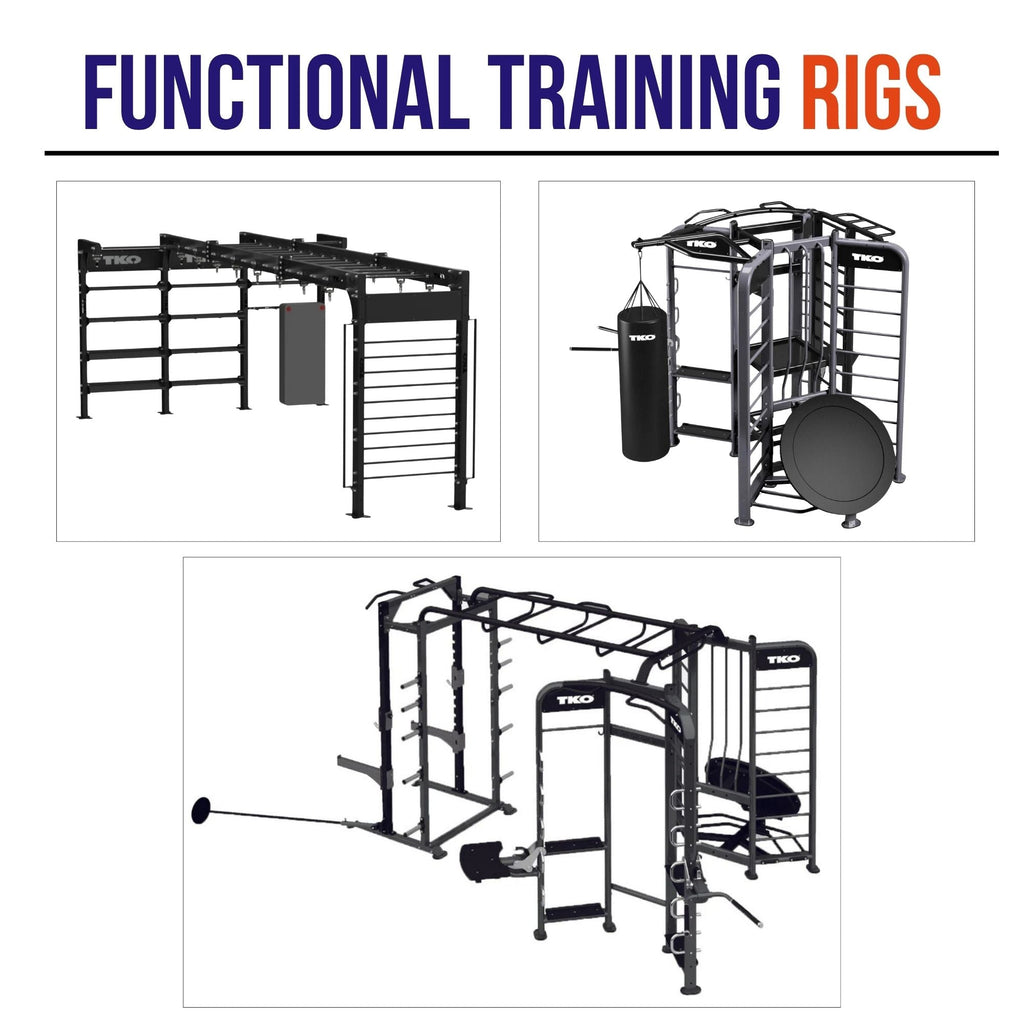
    A functional training rig is primarily designed as a training structure for exercises such as lifting, pull-ups, suspension work, attachments, and functional movements. Storage may be available, but it isn't necessarily the system's defining purpose.

    Competitors Outlet separates these categories so facilities looking primarily for a training rig can shop Functional Training Rigs, while buyers looking for modular storage-led systems can shop here.

  • Yes. Depending on the system, a storage bay may incorporate suspension training, power or half racks, cable columns, Smith machines, bridges, heavy bags, conditioning stations, stall bars, or other training capabilities.

    Use the System Type and Training Features filters together to narrow the collection.

  • A suspension training bay combines equipment storage with structural anchor points or stations for suspension trainers.

    This allows a facility to store accessories and perform suspension-based bodyweight exercises within the same area, which can be particularly useful for personal training studios, group training spaces, schools, and compact commercial gyms.

  • Start with the amount and variety of equipment you need to store, then consider how many people may need access at the same time.

    A single bay can work well for a focused accessory area. Double bays provide more separation between equipment categories. Triple and quadruple configurations can provide additional storage zones or training positions for larger facilities.

    Bay count should reflect capacity and use, not simply the physical size of the room.

  • Choose a wall-mounted system when you want to use perimeter space efficiently and keep the center of the room open.

    A freestanding system can provide more placement flexibility and, depending on its design, may allow storage or training access from multiple sides.

    The right choice depends on the room layout, wall construction, traffic flow, and training functions you need.

  • Clearance depends on what the system does.

    A storage-only bay mainly needs enough room for users to safely retrieve and return equipment. Rack, suspension, cable, heavy-bag, bridge, and conditioning configurations require additional working space for exercise.

    Always plan around the active training footprint, not only the published dimensions of the frame.

  • Not always. Product images may show dumbbells, kettlebells, medicine balls, suspension trainers, bars, plates, heavy bags, or other accessories to demonstrate how the system can be configured.

    Only treat an accessory as included when it is specifically listed with the sellable SKU. Use the Accessories Included filter and review the individual product's included-components list before ordering.

  • Depending on the system and its storage components, bays may accommodate kettlebells, dumbbells, medicine balls, resistance bands, ropes, bars, weight plates, mats, handles, and other functional-training accessories.

    Storage compatibility varies by model, so match the shelves, trays, hooks, and holders to the equipment your facility actually owns.

Get Help Planning Your Storage & Training System

Tell us about your facility, available space, equipment inventory, and training needs. We'll help you compare storage and training systems that fit the way your gym actually operates.

Send us a message